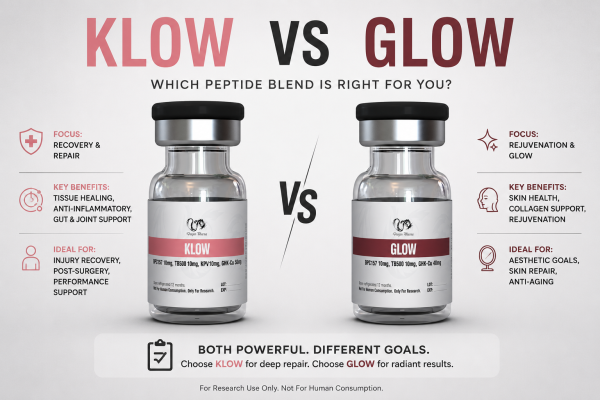
Two blends. Four overlapping peptides. One critical difference.
KLOW and GLOW are Dragon Pharma flagship multi-peptide formulations built around the same three-compound collagen-and-repair core, with one meaningful distinction: KLOW adds a fourth peptide, KPV, that directly targets the inflammatory pathways GLOW leaves unaddressed.
The choice between them comes down to a single question: is inflammation part of the picture? This guide covers what each blend contains, how every component works, when to choose one over the other, and current dosage protocols.
KLOW vs GLOW: at a glance
| Feature | GLOW 70mg | KLOW 80mg |
|---|---|---|
| Total peptide content | 70 mg | 80 mg |
| Number of peptides | 3 | 4 |
| GHK-Cu | 50 mg | 50 mg |
| BPC-157 | 10 mg | 10 mg |
| TB-500 (TB-4) | 10 mg | 10 mg |
| KPV (anti-inflammatory) | Not included | 10 mg |
| Best suited for | Collagen maintenance, anti-aging, baseline skin quality | Reactive skin, rosacea, post-procedure recovery, inflammatory acne |
| Switching | Identical dosing — switching is a single vial swap | |
What is the GLOW peptide blend?
GLOW is Dragon Pharma peptides-blend formulation: GHK-Cu (50 mg), BPC-157 (10 mg), and TB-500 (10 mg) in a single 70 mg lyophilised vial. GHK-Cu dominates at 50 mg because collagen synthesis is the continuous long-horizon demand the protocol is built around. BPC-157 and TB-500 supply the vascular and cellular scaffolding collagen production depends on.
GLOW targets skin regeneration and dermal remodelling in a calm, non-inflamed baseline state, addressing three of the four main mechanisms of skin ageing: collagen gene expression, microvascular support, and organised cell migration.
GHK-Cu (copper tripeptide-1) — 50 mg
GHK-Cu is a naturally occurring copper complex first isolated from human plasma in the 1970s. Serum levels decline with age from ~200 ng/ml at 20 to ~80 ng/ml by 60. Key mechanisms: COL1A1/COL3A1 collagen gene activation; SOD and catalase antioxidant upregulation; modulation of over 4,000 genes governing wound repair and extracellular matrix; stimulation of hyaluronic acid, dermatan sulphate, and heparan sulphate synthesis.
“GHK-Cu modulates the expression of over 4,000 human genes and restores fibroblast gene expression to a younger phenotype.”
— Pickart L, Margolina A. Int J Mol Sci, 2018
BPC-157 — 10 mg
BPC-157 primary role in GLOW is angiogenesis — forming the new blood vessels that supply GHK-Cu collagen-building work. Mechanism: VEGF upregulation driving capillary sprouting; tight junction maintenance for epithelial barrier integrity; nitric oxide pathway modulation for local tissue oxygenation.
TB-500 (Thymosin Beta-4) — 10 mg
TB-500 central function is actin regulation — coordinating cell migration so fibroblasts and keratinocytes reach remodelling sites efficiently. It also modulates TGF-beta to reduce scarring and shifts macrophages toward the repair-promoting M2 phenotype.
What is the KLOW peptide blend?
KLOW is GLOW plus KPV (10 mg). Vial content rises from 70 mg to 80 mg. The mechanism profile expands to all four major bottlenecks simultaneously. The name reflects the formula: KPV + GLOW. KLOW is the complete version of the protocol. GLOW is KLOW without the inflammation layer.
KPV (Lys-Pro-Val) — 10 mg
KPV is a tripeptide derived from the C-terminal sequence of alpha-melanocyte-stimulating hormone. Its mechanism is NF-kB inhibition — preventing the inflammatory switch from activating before pro-inflammatory cytokines are produced, rather than blocking them downstream after the fact. Normal immune signalling required for healing stays intact.
“KPV inhibited NF-kB activation and reduced multiple pro-inflammatory cytokines in inflamed epithelial cells.”
— Dalmasso G et al. J Clin Invest, 2008
The four-pathway mechanism
| Bottleneck | Mechanism | Peptide |
|---|---|---|
| Collagen gene under-expression | COL1A1/COL3A1 upregulation, MMP balance | GHK-Cu |
| Inadequate microvascular supply | VEGF angiogenesis, capillary formation | BPC-157 |
| Disorganised cell migration | Actin sequestration, TGF-beta regulation | TB-500 |
| Chronic inflammation disrupting repair | NF-kB inhibition, cytokine suppression | KPV |
Which blend should you choose?
Choose GLOW if:
- The objective is collagen synthesis in a non-inflamed baseline state
- No active rosacea, reactive flushing, or inflammatory acne is present
- The protocol is for general anti-ageing and skin rejuvenation maintenance
- A focused three-compound system is preferred for research isolation
Choose KLOW if:
- Inflammation is an active variable — rosacea, reactive skin, post-procedure erythema, acne-driven damage
- The protocol addresses gut-linked skin inflammation (KPV epithelial mechanism is directly relevant)
- The subject is on a GLP-1 protocol where caloric deficit increases inflammatory burden
- Post-procedure recovery — laser resurfacing, microneedling, chemical peels
- A comprehensive four-pathway system is the research objective
KLOW is the complete version of the protocol. When in doubt, KPV adds a layer without removing one — it does not impair the mechanisms of the other three peptides.
Dosage and protocol guide
Reconstitution
Both vials are lyophilised powder. Reconstitute with 2 ml bacteriostatic water injected slowly down the inside vial wall. Swirl gently — do not shake. Store at 2-8°C. Use within 4 weeks. Resultant concentration: 40 mg/ml (KLOW), 35 mg/ml (GLOW).
| Protocol level | Daily dose | Injection volume | Duration |
|---|---|---|---|
| Conservative | 500 mcg/day | 12.5 units (insulin syringe) | 4-6 weeks |
| Standard | 750 mcg/day | 19 units | 6-8 weeks |
| Advanced | 1,000 mcg/day | 25 units | 8 weeks then assess |
| Maintenance | 500 mcg, 2-3x weekly | 12.5 units per injection | Ongoing |
Cycle structure: 8-12 weeks active, 4-8 weeks off or step to maintenance. Identical schedule for KLOW and GLOW — switching requires only a vial swap. Route: subcutaneous (SubQ), 27-29 gauge, 4-8 mm needle, abdomen or thigh.
Stacking with other Dragon Pharma peptides
- NAD+ (100-200 mg IM, 2-3x weekly): Cellular energy substrate for the repair work GHK-Cu signals — the most common KLOW/GLOW add-on.
- Epitalon peptide (5-10 mg daily): Telomere biology and longevity signalling alongside the tissue-level work of KLOW/GLOW.
- Semax or Selank: Nootropic peptides with no mechanistic conflict — suitable for protocols with a neurological dimension.
- Sema-Pep or Tirze Pep: GLP-1 rapid weight loss outpaces skin remodelling. KLOW alongside a GLP-1 protocol supports collagen synthesis through the weight-loss curve. KLOW preferred over GLOW due to increased inflammatory burden during caloric deficit.
Safety profile and side effects
KLOW and GLOW contain no androgenic, oestrogenic, or hepatotoxic compounds. No aromatisation, no liver stress, no hormonal axis suppression — no post-cycle therapy required.
Commonly reported observations
- Injection site reactions: Mild redness or tenderness, resolving within 24-48 hours. Rotate sites each administration.
- Transient fatigue: Occasional at protocol initiation, typically self-resolving within 1-2 weeks.
- Mild headache: Infrequent, associated with early GHK-Cu protocols.
- Flushing (KLOW only, rare): Dose-dependent, not consistent across subjects.
What KLOW and GLOW do not cause
- No androgenic side effects (acne, hair loss, aggression)
- No water retention or oedema
- No hepatotoxicity
- No aromatisation or oestrogenic effects
- No hormonal axis suppression — no PCT required
- No cardiovascular strain at research-range doses
Dragon Pharma pharmaceutical-grade manufacturing
The efficacy of any peptide blend is inseparable from purity and compositional accuracy. Underdosed or contaminated blends produce unreliable results — particularly in multi-compound formulations where ratios must be precise.
- Pharmaceutical-grade synthesis: The stated 50/10/10 (GLOW) and 50/10/10/10 (KLOW) ratios are analytically verified per batch.
- Third-party COA testing: Peptide identity confirmed by mass spectrometry, purity by HPLC, available on request.
- Lyophilised for stability: No hydrolysis degradation during storage or transit.
- Consistent batch-to-batch composition: Each order is chemically identical to the last.
Frequently asked questions
What is the main difference between KLOW and GLOW?
KLOW adds KPV — a tripeptide NF-kB inhibitor — to GLOW three-compound base. GLOW covers collagen synthesis, angiogenesis, and cell migration. KLOW adds active inflammation control to those three mechanisms.
Can I switch from GLOW to KLOW mid-cycle?
Yes. Dosing schedule, injection frequency, and reconstitution are identical. Switching is a single vial swap with no protocol adjustment needed.
Do KLOW or GLOW require post-cycle therapy?
No. Neither blend suppresses the HPG axis. No testosterone suppression, no oestrogen disruption, no SERMs or aromatase inhibitors required.
How long before results are observed?
KPV anti-inflammatory effect is fastest — reactive redness often settles in 1-2 weeks. GHK-Cu collagen effects show at 6-8 weeks. Full protocol assessment is most meaningful at 10-12 weeks.
Is KLOW better for post-laser or post-microneedling recovery?
Yes. Post-procedure recovery involves deliberate controlled inflammation. KLOW KPV modulates this response while BPC-157 supports angiogenesis and TB-500 coordinates cell migration for clean remodelling.
Can KLOW or GLOW be used alongside semaglutide?
Yes — KLOW is preferred. GLP-1 rapid weight loss outpaces skin remodelling. KLOW GHK-Cu supports collagen synthesis through the weight-loss curve while KPV addresses the inflammatory burden that caloric deficit amplifies.
What is the difference between TB-4 and TB-500?
TB-500 is a synthetic fragment of full-length TB-4, corresponding to its actin-binding sequence. Dragon Pharma KLOW and GLOW use full-length TB-4, which also carries TGF-beta modulation, M2 macrophage polarisation, and broader systemic signalling.
Is there evidence for KLOW or GLOW as a combined formulation?
No controlled human trial has evaluated either blend as a combined formulation. Evidence exists for each component individually. The rationale is mechanistic complementarity — each peptide addresses a different bottleneck — not a trial of the exact combined ratio.
The bottom line
GLOW and KLOW are not competing products — they are two versions of the same protocol. GLOW is right when the objective is collagen synthesis in calm, non-inflamed skin. KLOW is the complete version: GLOW three mechanisms plus NF-kB-directed inflammation control. When inflammation is present or suspected, KLOW removes a bottleneck that GLOW leaves open.
Explore Dragon Pharma full peptide range, including GHK-Cu, BPC-157, TB-500, and the KLOW and GLOW product pages, or contact our team for batch COA documentation.