

Understanding Multi-Ester Testosterone Blends: The Science of Layered Release Kinetics
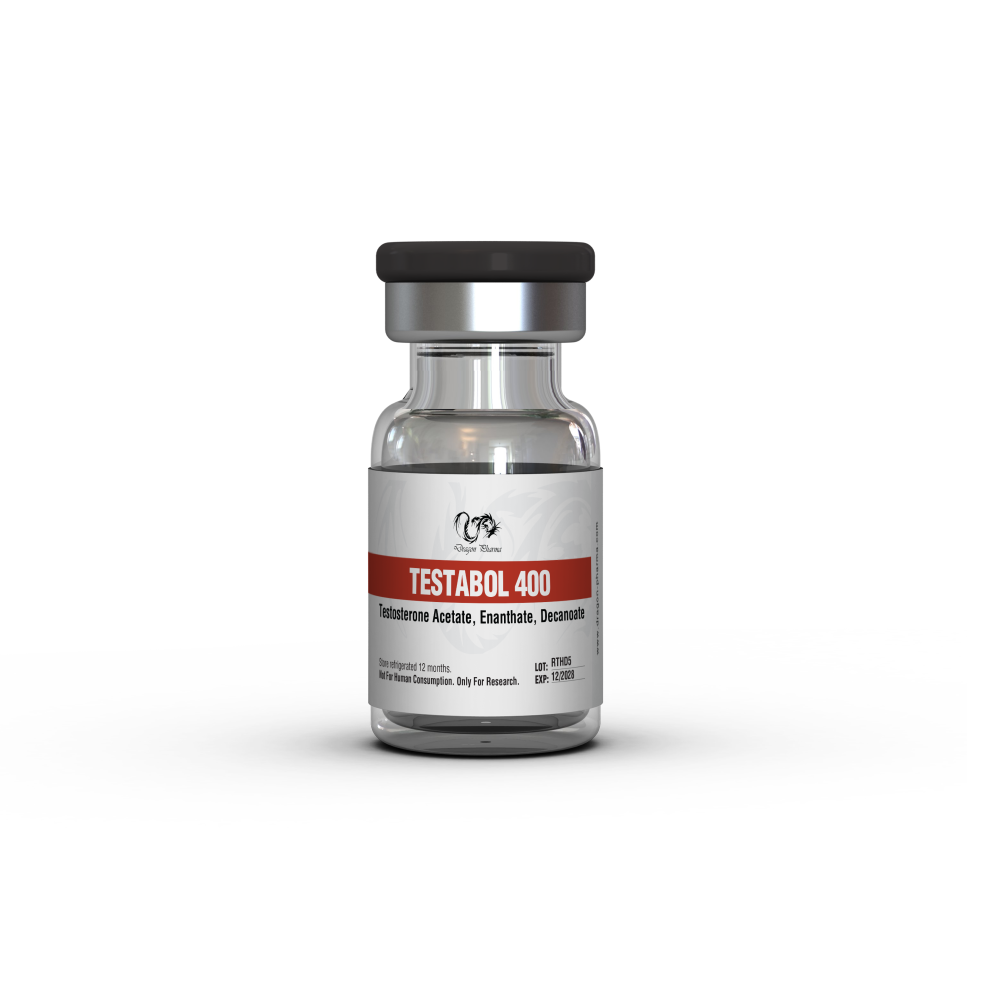
Core Information
| Classification | Testosterone Blend (Anabolic-Androgenic Steroid) |
| Active Ingredients |
Testosterone Acetate – 60 mg Testosterone Enanthate – 142 mg Testosterone Decanoate – 198 mg |
| Total Strength | 400 mg/mL |
| Presentation | 10 mL Multi-Dose Vial |
| Manufacturer | Dragon Pharma |
| Active Life | Approximately 10–14 days |
| Typical Dosage | 400–800 mg per week |
| Aromatization Potential | High |
| Liver Toxicity | None |
| Anabolic Rating | 100 |
| Androgenic Rating | 100 |
Overview
Dragon Pharma Testosterone Blend 400 is a multi-ester testosterone formula designed to provide both rapid hormone activity and long-lasting testosterone release. Each milliliter contains a combination of Testosterone Acetate, Testosterone Enanthate, and Testosterone Decanoate, offering a balanced release profile that combines fast onset with extended stability.
The inclusion of short-, medium-, and long-acting esters helps maintain more consistent hormone levels while reducing the need for overly frequent injections. Dragon Pharma Testosterone Blend 400 is commonly used during mass-gaining phases, strength-focused cycles, and long-term testosterone protocols where sustained anabolic support is desired.
Due to its high testosterone concentration of 400 mg/mL, this blend is often chosen by experienced users seeking a convenient, high-potency injectable testosterone option. As with other testosterone-based compounds, monitoring estrogen-related effects and maintaining appropriate cycle support is recommended.
Anyone who has researched injectable testosterone esters eventually runs into the same question: why use a single ester when you could combine several? Single-ester compounds like Testosterone Cypionate or Testosterone Enanthate have dominated TRT and performance protocols for decades, largely because their pharmacokinetics are simple and predictable. But predictability isn’t the same as optimal — and that’s the gap multi-ester testosterone formulations are designed to close.
To understand why a compound like Dragon Pharma’s Testabol 400 exists at all, it helps to step back from the product itself and look at the underlying pharmacokinetic problem multi-ester blends are trying to solve.
The Single-Ester Problem: Peaks, Troughs, and Injection Frequency
Every testosterone ester has an absorption rate determined by its molecular side chain. Shorter chains like propionate or acetate release into circulation rapidly but clear quickly, requiring frequent injections to avoid hormonal troughs. Longer chains like enanthate, cypionate, or decanoate diffuse slowly from the injection depot, producing flatter, longer-lasting curves but with a delayed onset before blood concentrations reach a meaningful level.
This creates an unavoidable trade-off in single-ester protocols: researchers either accept frequent injections for stability, or accept a slower ramp-up period in exchange for fewer administrations. Neither option eliminates the underlying sawtooth pattern of rising and falling testosterone concentrations between doses — a pattern well documented in pharmacokinetic literature on depot injection absorption.
The Multi-Ester Solution: Engineering a Composite Curve
Multi-ester blends approach the problem differently. Rather than relying on injection frequency to smooth out the curve, they combine esters with different absorption rates in a single injection — engineering a composite release curve where each ester’s individual pharmacokinetic profile overlaps with the others.
In a triple-ester formulation, the mathematics work roughly like this: the shortest ester produces an early concentration spike that begins declining within days, but by the time it’s clearing, the medium-length ester is reaching its own peak absorption. As the medium ester begins to taper, the longest ester — which has been diffusing slowly since injection — is just reaching its steady-state contribution. The result, in theory, is a flatter composite curve than any single ester could produce alone, without requiring daily injections.
This is the underlying logic behind blends like Testabol 400, which layers Testosterone Acetate, Testosterone Enanthate, and Testosterone Decanoate at calculated ratios specifically to stagger their individual absorption windows.
Why Ratio Design Matters More Than Ester Count
It’s worth noting that simply combining esters doesn’t automatically produce a smoother curve — the ratio between them determines whether the composite curve is actually flatter, or whether it just shifts where the peaks occur. A blend weighted too heavily toward short esters will still show early volatility; one weighted too heavily toward long esters will behave almost like a single long-ester compound with a higher total dose.
This is the design distinction between different multi-ester products on the market. Some formulations — like Sustanon-style blends — distribute weight more evenly across four esters. Others, like long-ester-dominant triple blends, intentionally weight the formulation toward the longer-acting component for users prioritizing fewer injections over a more aggressive early ramp-up. Understanding this ratio logic is more useful for research purposes than simply counting how many esters a product contains.
Practical Implications for Injection Scheduling
One often-overlooked consequence of multi-ester design is how it changes injection scheduling logic compared to single-ester protocols. With a single long ester, the injection interval is calculated almost entirely around that one compound’s half-life. With a multi-ester blend, the scheduling question becomes more nuanced: injecting too infrequently allows the short ester’s contribution to fully clear between doses, partially reintroducing the volatility the blend was designed to avoid.
This is why most research protocols involving multi-ester testosterone blends — including formulations similar to Dragon Pharma’s Testabol 400 — tend to favor splitting weekly volume across two administrations rather than a single weekly injection, even though the long-ester component alone could theoretically support a once-weekly schedule.
Where This Fits in Broader Cycle Design
From a research design standpoint, multi-ester blends are most often discussed in the context of mass and strength-focused protocols rather than precision TRT replacement — largely because TRT research typically prioritizes the simplicity and predictability of a single, well-characterized ester. Multi-ester blends tend to appear instead in performance-focused literature discussing extended cycles, where the priority shifts toward maintaining consistently elevated concentrations over many weeks with manageable injection frequency.
This distinction matters for anyone trying to map academic pharmacokinetic literature onto real-world product formulations — the existence of a product doesn’t tell you which research context it’s intended for; the ester ratio and total concentration do.
The Bigger Picture
Multi-ester testosterone formulations represent a pharmacokinetic engineering solution to a problem that’s existed since injectable testosterone esters were first developed: how do you maintain stable hormone concentrations without requiring constant injections? There’s no perfect answer — every formulation involves trade-offs between onset speed, curve stability, and injection frequency — but understanding the underlying absorption mathematics makes it much easier to evaluate any specific product, whether that’s a triple-ester blend, a four-ester Sustanon-style formulation, or a single long ester used at a higher dose.
For readers interested in browsing actual multi-ester and single-ester testosterone formulations based on this framework, view all available formulations includes both approaches across different concentration and ester-ratio profiles.