

Why Long-Ester Testosterone Became the Default Choice in Hormone Optimization Protocols
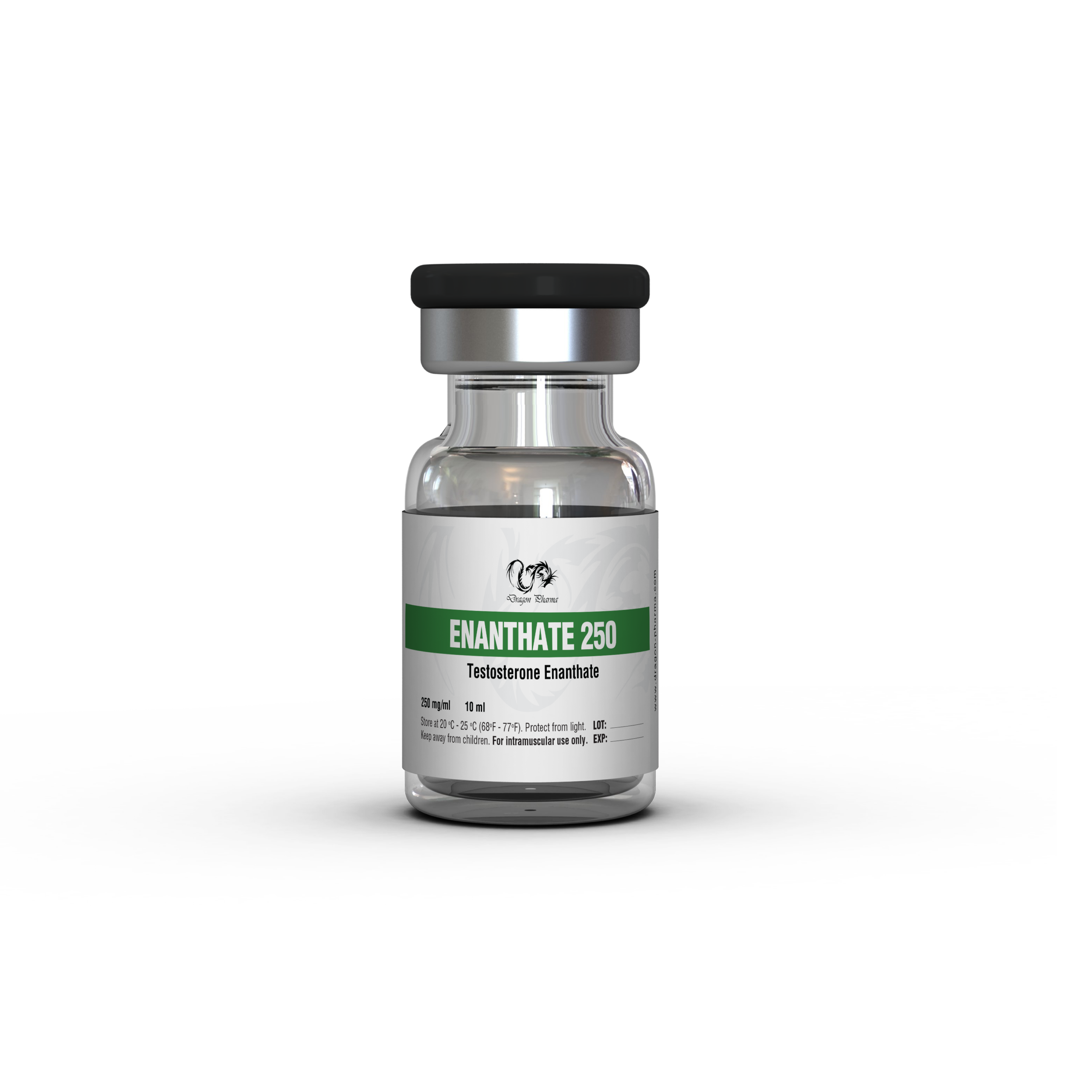
Core Information
| Classification | Injectable Anabolic-Androgenic Steroid |
| Active Ingredient | Testosterone Enanthate – 250 mg/mL |
| Strength | 250 mg/mL |
| Active Life | Approximately 15–16 days |
| Typical Dosage | 300–2000 mg per week |
| Aromatization Potential | High |
| Liver Toxicity | Low |
| Anabolic Rating | 100 |
| Androgenic Rating | 100 |
| Manufacturer | Dragon Pharma |
Overview
Dragon Pharma Testosterone Enanthate 250 is a long-acting testosterone ester designed to provide stable hormone levels and sustained anabolic support throughout a cycle. As one of the most widely used injectable testosterone compounds Testosterone Enanthate is commonly utilized for muscle growth, strength development, recovery enhancement, and testosterone replacement protocols.
The Enanthate ester slows the release of testosterone into the bloodstream, allowing for less frequent injections compared to shorter esters such as Testosterone Propionate. This extended release profile helps maintain more consistent hormone concentrations, making it a popular choice for both beginner and advanced users.
Dragon Pharma Testosterone Enanthate 250 is frequently incorporated into bulking, lean mass, and long-term performance-focused cycles. Due to its strong anabolic and androgenic properties, it is often used as a foundational compound and commonly stacked with other injectable or oral anabolic agents depending on individual goals.
If you look across decades of testosterone-based research and clinical protocols, one ester chain length shows up far more often than any other: the seven-carbon enanthate chain. It’s not the fastest-acting option, nor the longest-lasting — yet it became something close to a default standard in both TRT literature and performance research. Understanding why requires looking past the compound itself and into the underlying chemistry of ester chain length and depot absorption kinetics.
The Ester Chain Length Spectrum
Testosterone itself is not particularly useful as an injectable — unmodified testosterone clears from circulation within hours, making it impractical for anything but emergency or highly specialized protocols. Esterification solves this by attaching a fatty acid side chain to the testosterone molecule, which delays its release from the injection depot and extends the time before the ester bond is hydrolyzed and free testosterone becomes bioavailable.
The length of that side chain determines how slowly this happens. Short chains like propionate (3 carbons) hydrolyze quickly, producing rapid release but requiring injections every 1–3 days to avoid troughs. Long chains like decanoate (10 carbons) hydrolyze far more slowly, extending the release window to several weeks but delaying the time before concentrations reach a therapeutic plateau. Enanthate, at seven carbons, sits in a middle zone that turns out to be unusually well-suited to weekly or twice-weekly dosing intervals.
Why the Middle of the Spectrum Won
The reason enanthate-length esters became so widely adopted isn’t because they’re chemically superior in some absolute sense — it’s because they happen to match human injection-frequency preferences better than either extreme. A propionate-based protocol theoretically offers tighter control over blood concentrations, but the injection burden makes long-term compliance difficult outside of clinical supervision. A decanoate-based protocol reduces injection frequency further, but the slow onset means weeks pass before concentrations stabilize, and any dosing adjustment takes proportionally longer to show its effect.
Enanthate occupies a practical middle ground: a half-life in the range of five to ten days allows weekly or twice-weekly injection schedules to maintain relatively stable concentrations without the steep early volatility of shorter esters or the sluggish adjustment period of longer ones. This is less a statement about enanthate being objectively optimal and more about it aligning well with how often people are realistically willing to self-administer injections.
The Steady-State Concept in Practice
Pharmacokinetic literature describes a concept called steady-state — the point at which the amount of compound entering circulation from each new injection roughly balances the amount being cleared, producing relatively stable concentrations over time rather than continuing to climb or fall. Reaching steady-state with any ester takes multiple half-lives, which is why protocols using mid-length esters typically don’t reach their full stable concentration until several weeks into consistent dosing.
This has a practical research implication that’s often underappreciated: early-cycle blood levels and subjective effects don’t necessarily represent what the protocol will look like at steady-state. Researchers evaluating a mid-length ester protocol need to account for this ramp-up period when interpreting early data, rather than assuming week-one observations will hold throughout the full cycle.
Why Clinical TRT Protocols Gravitated Toward Mid-Length Esters
It’s worth noting that clinical hormone replacement research had different priorities than performance-focused literature, yet both converged on similar ester lengths. In clinical contexts, the priority was minimizing the peak-to-trough swing that patients describe as feeling emotionally and physically unstable across the dosing interval — a known issue with shorter esters administered infrequently. Mid-length esters administered weekly reduced this swing meaningfully compared to older protocols using even longer-acting esters dosed monthly, which produced more pronounced symptomatic troughs near the end of each cycle.
This convergence between clinical and performance contexts — different goals, similar ester-length conclusion — is part of why mid-length testosterone esters appear so consistently across such different bodies of literature.
What Determines Whether a Protocol Needs a Different Ester
None of this means mid-length esters are universally correct. Research contexts prioritizing rapid titration — where dose adjustments need to show measurable effect quickly — often favor shorter esters despite the injection burden. Contexts prioritizing absolute minimum injection frequency, where compliance is the primary failure point being studied, may favor longer esters despite the slower onset. The ester-length decision is really a trade-off analysis specific to what a given protocol is optimizing for, not a search for one universally superior option.
This is also why multi-ester blends exist as a separate category — rather than choosing one point on the spectrum, they attempt to combine several ester lengths in a single formulation to capture benefits from multiple points simultaneously, at the cost of more complex absorption kinetics to model and predict.
The Bigger Takeaway
The popularity of mid-length testosterone esters across both clinical and performance research isn’t really a story about one compound being superior — it’s a case study in how pharmacokinetic theory and practical human behavior intersect. The “best” ester length on paper means little if a protocol’s adherence rate collapses because the injection schedule isn’t sustainable. Understanding this trade-off is more useful for evaluating any testosterone ester protocol than focusing on any single compound in isolation.
For readers interested in comparing specific ester-length formulations side by side — including mid-length, long-ester, and multi-ester blended options — Dragon Pharma’s testosterone category includes products spanning this entire spectrum, from shorter-acting esters through long-ester and blended multi-ester formulations.
Those specifically researching the seven-carbon mid-length ester discussed throughout this article can find a detailed product breakdown at Dragon Pharma’s Enantat 250 page, which covers concentration, dosing structure, and stacking considerations for this specific formulation.